
Why Editing and Proofreading Are Important

Good writing consists 70% of editing and proofreading. As a small business owner, you should take these two more into consideration before you upload content on your company’s blog or write an engaging social media post.
Not only can editing and proofreading improve your work and lure more prospects to your small online business, but they can also help you develop your writing skills. People who edit and proofread their own work improve their writing with each piece of text.
Life Story
The $7 Million Typo: When Alitalia Accidentally Sold $3,900 Tickets for $39
One of the most legendary typos in business happened in 2006, when Alitalia Airlines accidentally listed business-class flights from Toronto to Cyprus for $39 instead of $3,900.
Yes — thirty-nine dollars.
For a business class international flight.
Thousands of people saw the mistake, bought the tickets immediately, and shared the deal like wildfire on travel forums.
When Alitalia realized what had happened, they tried to cancel the tickets.
But customers fought back, pointing out that:
- The price was listed on the official website
- It was offered for hours
- People purchased in good faith
Eventually, the airline gave up and honored most of the tickets. The typo is estimated to have cost them over $7 million.
Sloppy writing can make readers confused. In the world of business, this can be suicidal. Luckily, editing exists, and you should take advantage of it and make your pieces of business writing clearer and more concise. Even a missing letter or a typo can create serious confusion that only a proofreader can fix, so don’t take that risk.
Of course, editing and proofreading do not require innate talent. They are skills that anyone can learn and continuously improve. If you want to handle your online content better and by yourself, then learning how to edit and proofread like a professional is a must.
In what follows, we hope that you learn some of the basics of editing and proofreading. While it does take time to better these crafts, anyone can manage to improve their writing skills in this regard.
The Difference Between Editing and Proofreading
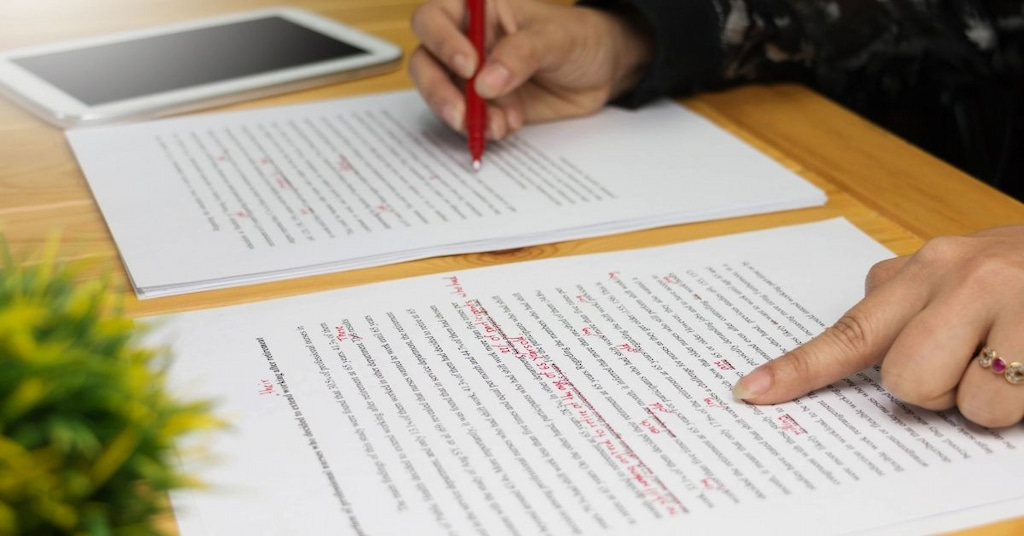
In a previous article, we discussed two important concepts—line and copy editing. You can understand the differences between editing and proofreading by comparing them with line and copy editing.
A proofreader focuses more on the text being written correctly. The proofreader searches for typos and whether you broke certain writing rules and conventions. Also, punctuation stands in the realm of proofreading. A missing comma or a comma splice is an error that must be corrected by the proofreader.
A proofreader looks at the text and changes it for the better without altering meanings, similarly to the copy editor.
Proofreading Example
Before: “Your sucess depends on how clear you comunicate.”
After: “Your success depends on how clearly you communicate.”
On the other hand, editing is more complex and nuanced. The goal is not to simply make the text clearer, but to improve it. An editor looks for stronger verbs, more concrete nouns, and better flow. In business, this is important because you want the reader to get the answers and be persuaded by your text.
Editing has to do with clarity, logic, structure, flow, and tone.
Editing Example
Before: “Our product helps entrepreneurs grow faster by offering many different tools for business improvement and making everything easier.”
After: “Our product helps entrepreneurs grow faster with simple, effective business tools.”
How to Edit like a Professional

Now that you understand the differences between editing and proofreading, it’s time to see how to edit like a professional.
You first need to begin with the big picture. You should have the main message of your writing in mind. Look at every paragraph and chapter, and ask yourself if the main idea is sustained throughout your text.
Here, flow and logic are important. Of course, your main idea won’t appear in each paragraph, but the subordinate ideas found in these smaller text units need to be knitted to your text’s main idea.
After the structure has been handled, it’s time to review each sentence and see if they are all in order. Look for fluff. Are there any unnecessary words? Are some of the words redundant? W. Strunk, in his famous Elements of Style said that every needless word should be removed.
“Vigorous writing is concise. A sentence should contain no unnecessary words, a paragraph no unnecessary sentences… for the same reason that a drawing should have no unnecessary lines and a machine no unnecessary parts.” Strunk, Elements of Style
This links to another technique that helps you in your editing efforts: making sentences shorter. Shorter sentences are often more concise and help the reader understand the message better. This is why removing needless words is imperative if you are trying to improve your writing skills through editing and proofreading. For example, sentences written using the passive voice should be written in the active one. This way, the sentence becomes more concise. Also, a lot of qualifiers and adverbs are useless for the meaning of the sentence. Delete them.
After you have worked on the sentences, it’s time to zoom out again to the bigger picture and view the text as a whole. Now, you want to see if ideas flow logically from one paragraph to the other. For this, you want to add transitional words for flow, remove them if they function as simple fillers, or change them if they affect diction.
Also, be careful of loose sentences and monotony. If each sentence is of one kind (simple, complex, compound) and of similar length, this will affect the rhythm of the piece. Here, you can apply a simple test: read the piece out loud. If the flow is good, then the text is well written.
The last elements that your editing should take into consideration are the words and phrases. Keep the writing personal, confident, and entrepreneur-friendly. Of course, your word choice depends on the target audience. But in most cases, you will write for a wide audience. That’s why you must leave the jargon aside and use simple English words. Not only that, but jargon terminology is abstract. A key element in your editing is that you should use concrete language.
Finally, you need to maintain consistent formatting. Use the same formats for your headings, use proper and consistent spacing, and use lists properly.
Proofreading Your Texts like a Professional

Unlike editing, which requires inspiration and intuition, proofreading is more technical. It requires you to go word by word through the text, doing detective work to spot potential errors.
The first recommendation we give is to print out the text. Working with a pen and paper helps you more easily come across errors in typography and not only. By doing this, you will spot missing commas or letters.
Of course, missing words or awkward phrasing is a distinct problem. For this, we recommend that you read the text out loud. By doing so, you will manage to recognize more easily when a word is missing or when your writing is clumsy.
Two ways of approaching proofreading like a professional
If you want to be sure that you spot and correct all the errors, you can approach the issues in two distinct ways.
The first approach is to tackle the text in layers.
Instead of trying to catch every type of error at once, do focused passes:
> First pass: spelling and typos
> Second pass: punctuation
> Third pass: grammar
> Fourth pass: formatting
The second approach is to read the text from the end to the beginning. This way, you force your brain to read it as a true professional, looking for missing punctuation signs, typos, and other similar issues vigilantly.
A Word on Using Helping Tools

In the last ten years, tools for correcting spelling and grammar errors have improved. Now, with the rise of AI, complete editing options exist. For example, you can use ChatGPT to edit and proofread your text entirely. However, you need to be cautious.
AI tools like ChatGPT often hallucinate. They may edit your text incorrectly or ignore clear grammatical or punctuation rules. Other important tools out there, such as Grammarly or Quilt, are also not error-free. No matter how far AI technology goes, it will never beat human consciousness and intuition.
The best recommendation is to use them for what they are: tools. Editing and proofreading the texts yourself is the best option, while making good use of these free tools.
Editing and proofreading your own work is not something extra that you do for your online business. Sometimes a typo, a missing comma, or an added number can have dire consequences for your business. That’s why it is important to proofread your content.
Also, flow and logic may affect how the reader receives your message. That’s why ruthless editing is important for your business success.
Overall, editing and proofreading make you a better writer, and in the business world, this can only be beneficial for you and your company.
We hope that now you understand better how to edit and proofread like a professional.
Related posts:
 Cold Outreach vs. Job Boards: Which Is Better for a Beginner Freelance Writer?
The Best Remote Writing Jobs for 2025
Cold Outreach vs. Job Boards: Which Is Better for a Beginner Freelance Writer?
The Best Remote Writing Jobs for 2025
 Getting Started as a Freelance Writer: Where to Start?
Traps or Great Starting Points for Beginner Freelance Writers?
Getting Started as a Freelance Writer: Where to Start?
Traps or Great Starting Points for Beginner Freelance Writers?
